
At many intersections in the Netherlands, you won't find traffic lights, priority signs, or clear road markings. In these situations, knowing how to determine priority is essential for preventing accidents and ensuring smooth traffic flow. This page explains the general rules and important exceptions that apply at these 'uncontrolled' or 'equivalent' intersections.
Theory topic content overview
Read the full theory topic guide for Uncontrolled Intersections with structured, easy-to-scan content built for learners in the Netherlands. This detailed section explains the exact rule, meaning, traffic context, comparison points, and exam logic behind this Dutch driving theory topic so you can study faster, understand the concept more clearly, and avoid common interpretation mistakes on the theory test.
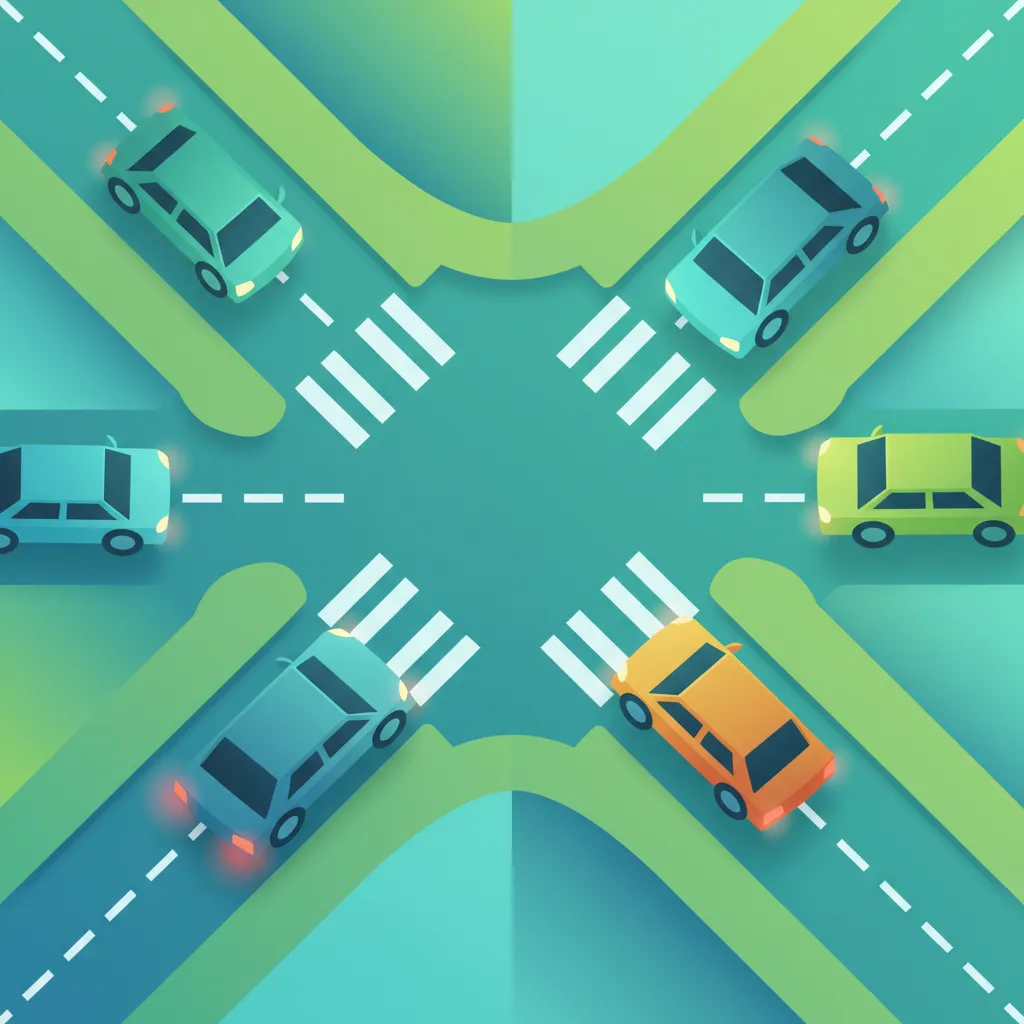
In the Netherlands, an uncontrolled intersection (or gelijkwaardige weg in Dutch) is a crossroads, T-junction, or Y-junction where the right of way is not regulated by traffic lights, priority signs (such as the triangular give-way sign or the diamond priority road sign), or shark’s teeth road markings.
Instead of signage, drivers at these junctions must rely on general traffic rules, observation, and communication to determine who has priority. The core principle governing these intersections is priority to the right (voorrang van rechts). This means that, in most cases, you must give way to any driver approaching from your right-hand side.
Understanding and correctly applying the rules at uncontrolled intersections is fundamental for safe driving in Dutch traffic and is a frequent topic on the CBR theory exam.
When approaching an uncontrolled intersection in the Netherlands, your first thought should be: "Is anyone coming from my right?"
Here's how to apply this rule:
While "priority to the right" is the general rule, there are critical exceptions in the Netherlands that often appear on the CBR exam:
Drivers on an unpaved road must always give priority to all drivers on a paved road, regardless of direction.
Trams always have priority in the Netherlands, regardless of where they are coming from or whether the intersection is controlled or uncontrolled.
Emergency vehicles (police, fire brigade, ambulance) with active flashing blue lights and siren always have priority over all other road users. You must give way and facilitate their passage safely.
To truly understand priority at uncontrolled intersections, it's vital to differentiate it from other scenarios:
Consider these common situations:
Learners frequently make these errors regarding uncontrolled intersections:
When approaching any intersection in the Netherlands, develop a clear mental checklist:
Always drive defensively, be prepared to yield even if you think you have priority, and make eye contact with other road users if possible to confirm intentions. Your ability to quickly and accurately assess these situations is key to passing your CBR theory exam and driving safely throughout the Netherlands.
At uncontrolled intersections in the Netherlands (gelijkwaardige wegen), the fundamental rule is priority to the right, meaning you must give way to any driver approaching from your right, including cyclists and moped riders. However, two critical exceptions override this rule: drivers on unpaved roads must always yield to those on paved roads regardless of direction, and trams always have priority regardless of their approach angle. Pedestrians are not considered 'drivers' in this context and do not automatically have priority even when approaching from your right. The CBR exam frequently tests these exceptions with subtle details like road surface type or tram presence, so always identify uncontrolled intersections first, then check for these overrides before applying the standard right-first rule.
A short set of high-value points that capture the most important ideas from this theory explanation.
At uncontrolled intersections in the Netherlands, you must always give way to drivers approaching from your right (voorrang van rechts)
Cyclists, moped riders, and mobility scooter users are all classified as 'drivers' and must be given priority when approaching from your right
Unpaved roads and trams are critical exceptions that override the basic 'priority to the right' rule
Pedestrians do not have automatic priority at uncontrolled intersections, even when approaching from your right
Road size or perceived importance does not determine priority—always look for signs first and apply the right-first rule only when no signs exist
If no signs, traffic lights, or shark's teeth markings are present, it is an uncontrolled intersection where 'priority to the right' applies
Drivers on unpaved roads must always yield to all traffic on paved roads, regardless of direction
Trams always have priority in the Netherlands, regardless of intersection type or direction of approach
Think of unpaved roads as having invisible haaientanden (shark's teeth) markings—you must always yield
Article 15 of the RVV 1990 is the legal basis for the 'priority to the right' rule at road junctions
Forgetting that unpaved roads and trams override the 'priority to the right' rule on the CBR exam
Assuming a wider or busier-looking road automatically has priority at an unmarked intersection
Granting priority to pedestrians from the right—legally they are not 'drivers' in this context
Only checking left or straight ahead without thoroughly scanning to the right for approaching vehicles
Hesitating or stopping unnecessarily when you actually have priority, disrupting traffic flow
Start with a short, direct summary of Uncontrolled Intersections before reading the full explanation below.
At uncontrolled intersections in the Netherlands, the general rule is to give way to drivers approaching from your right. These are often referred to as 'equivalent roads' (gelijkwaardige wegen) because no specific signage dictates priority. However, there are crucial exceptions, such as drivers on unpaved roads always yielding to those on paved roads, and trams always having priority. Always observe carefully and be prepared to yield, even if you think you have priority.
Review the most important terms, rule signals, and traffic concepts linked to Uncontrolled Intersections.
Explore related theory topic pages connected to Uncontrolled Intersections and continue with the next useful rule explanation.
See the common search queries learners use when trying to understand Uncontrolled Intersections in the Netherlands.

Ready to deepen your understanding? Browse our comprehensive library of Dutch driving theory topics, rules, and concepts. Each section offers detailed explanations to help you solidify your knowledge and prepare thoroughly for your upcoming CBR driving theory examination.
Explore Driving Theory TopicsTheory topic content overview
A short set of high-value points that capture the most important ideas from this theory explanation.
At uncontrolled intersections in the Netherlands, you must always give way to drivers approaching from your right (voorrang van rechts)
Cyclists, moped riders, and mobility scooter users are all classified as 'drivers' and must be given priority when approaching from your right
Unpaved roads and trams are critical exceptions that override the basic 'priority to the right' rule
Pedestrians do not have automatic priority at uncontrolled intersections, even when approaching from your right
Road size or perceived importance does not determine priority—always look for signs first and apply the right-first rule only when no signs exist
If no signs, traffic lights, or shark's teeth markings are present, it is an uncontrolled intersection where 'priority to the right' applies
Drivers on unpaved roads must always yield to all traffic on paved roads, regardless of direction
Trams always have priority in the Netherlands, regardless of intersection type or direction of approach
Think of unpaved roads as having invisible haaientanden (shark's teeth) markings—you must always yield
Article 15 of the RVV 1990 is the legal basis for the 'priority to the right' rule at road junctions
Forgetting that unpaved roads and trams override the 'priority to the right' rule on the CBR exam
Assuming a wider or busier-looking road automatically has priority at an unmarked intersection
Granting priority to pedestrians from the right—legally they are not 'drivers' in this context
Only checking left or straight ahead without thoroughly scanning to the right for approaching vehicles
Hesitating or stopping unnecessarily when you actually have priority, disrupting traffic flow
Start with a short, direct summary of Uncontrolled Intersections before reading the full explanation below.
At uncontrolled intersections in the Netherlands, the general rule is to give way to drivers approaching from your right. These are often referred to as 'equivalent roads' (gelijkwaardige wegen) because no specific signage dictates priority. However, there are crucial exceptions, such as drivers on unpaved roads always yielding to those on paved roads, and trams always having priority. Always observe carefully and be prepared to yield, even if you think you have priority.
Review the most important terms, rule signals, and traffic concepts linked to Uncontrolled Intersections.
Explore related theory topic pages connected to Uncontrolled Intersections and continue with the next useful rule explanation.
See the common search queries learners use when trying to understand Uncontrolled Intersections in the Netherlands.
Ready to deepen your understanding? Browse our comprehensive library of Dutch driving theory topics, rules, and concepts. Each section offers detailed explanations to help you solidify your knowledge and prepare thoroughly for your upcoming CBR driving theory examination.
Explore Driving Theory TopicsUse this exam-focused revision tip to understand how Uncontrolled Intersections is likely to appear in theory questions for learners in the Netherlands. This section helps you identify the most testable part of the rule, avoid common traps, and remember the concept more effectively during Dutch driving theory exam preparation.
The CBR exam often presents diagrams of uncontrolled intersections, sometimes with subtle details like an unpaved road or a tram, which are exceptions to the standard 'priority to the right' rule. Always identify if a road is paved or unpaved, and look for trams, as these override the basic rule. Never assume priority based on road size.
Read direct answers to the most common learner questions about Uncontrolled Intersections in the Netherlands. This FAQ focuses on rule confusion, practical meaning, comparison with similar concepts, and the exact uncertainties that appear most often in Dutch driving theory revision and exam preparation.
An uncontrolled intersection is one where there are no traffic lights, stop signs, give-way signs (haaietanden), or priority road signs (B-series signs) to indicate who has the right of way. Drivers must rely on general traffic rules, primarily 'priority to the right'.
The main rule, as per RVV 1990 Article 15, is to give way to all drivers approaching from your right side, unless specific exceptions apply. This applies when roads are considered 'equivalent' (gelijkwaardige wegen).
Yes, key exceptions in the Netherlands include: drivers on unpaved roads always yielding to drivers on paved roads, and trams always having priority over all other drivers at uncontrolled intersections, regardless of direction. Also, emergency vehicles with flashing lights and sirens always have priority.
No, the 'priority to the right' rule applies only between 'drivers'. Pedestrians are not considered drivers. Cyclists are drivers, so the rule applies between a car and a cyclist, but drivers turning must yield to all straight-going traffic, including cyclists and pedestrians on the road they are turning into.
Equivalent roads are two or more roads meeting at an intersection where no priority signs or markings are present. In such cases, all roads are considered equal in terms of priority, and the 'priority to the right' rule applies.
Always approach with caution and at a reduced speed, especially if visibility is limited. Be prepared to stop. Look left, then right, then left again to check for traffic. Make eye contact with other drivers to confirm intentions and be ready to yield even if you believe you have priority, to ensure safety.
No, the size or apparent 'busyness' of a road does not determine priority at an uncontrolled intersection in the Netherlands. If there are no signs, the 'priority to the right' rule applies, or the specific exceptions for unpaved roads or trams.
Leverage the targeted practice search to find questions that challenge your understanding of specific Dutch traffic rules or road signs. Focus your study efforts on areas where you need improvement and build a solid foundation for passing your CBR driving theory exam with confidence.