
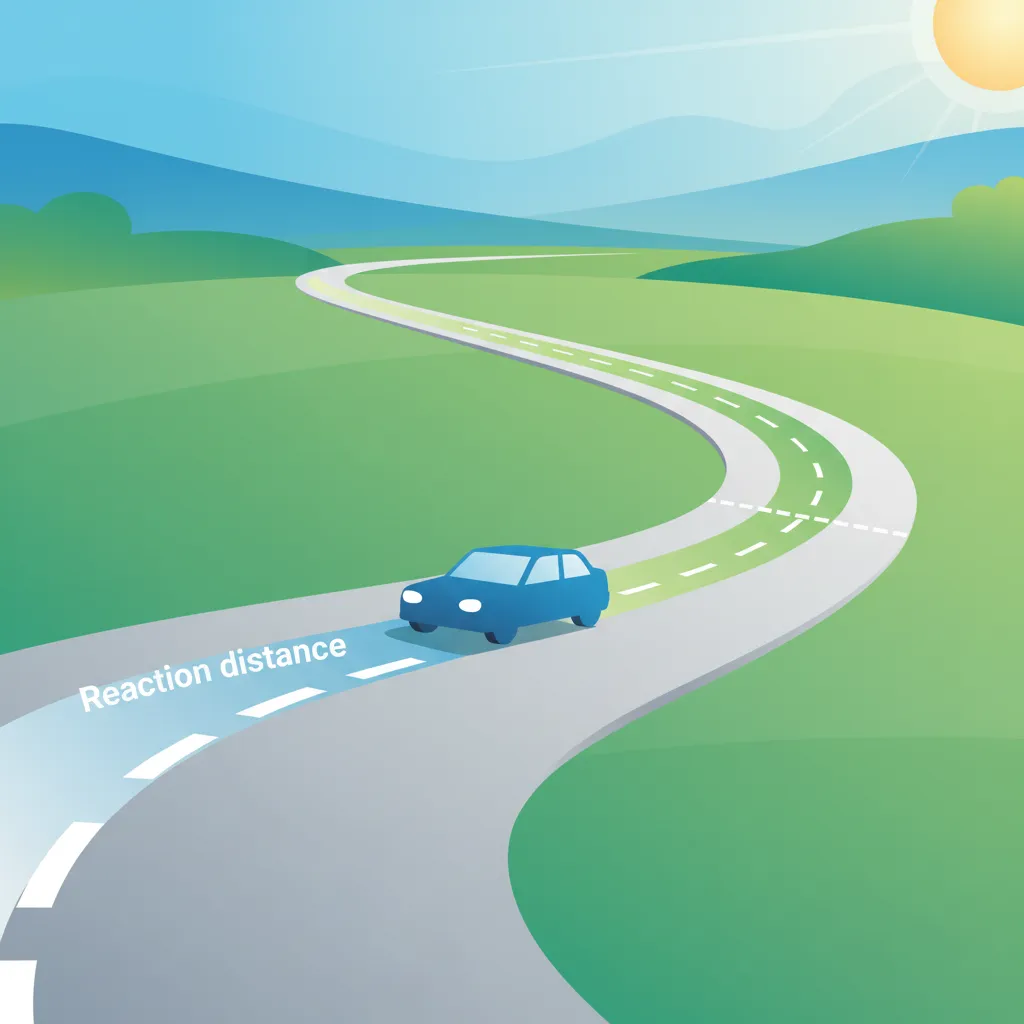
When you're driving, the total distance your vehicle needs to stop is comprised of two parts: the distance you travel while reacting to a hazard, and the distance you travel while actively braking. Both of these components are directly influenced by your speed. It's crucial to understand that stopping distance doesn't increase proportionally with speed; even a slight increase in speed can dramatically extend the distance required to come to a complete stop.
Theory topic content overview
Read the full theory topic guide for Speed & Stopping Distance with structured, easy-to-scan content built for learners in the Netherlands. This detailed section explains the exact rule, meaning, traffic context, comparison points, and exam logic behind this Dutch driving theory topic so you can study faster, understand the concept more clearly, and avoid common interpretation mistakes on the theory test.
Stopping distance is the total distance your vehicle travels from the moment you recognise a hazard until your vehicle comes to a complete stop. It is a fundamental concept in Dutch driving theory and crucial for road safety, directly influencing your ability to avoid collisions.
Stopping distance is composed of two primary parts:
Speed is the single most dominant factor affecting your total stopping distance. Even small increases in speed dramatically extend the distance required to stop, significantly reducing your safety margin on Dutch roads. This is a key principle for the CBR theory exam.
Your reaction distance is directly proportional to your speed. This means if you double your speed, you double the distance you travel during your reaction time.
While exact calculations aren't typically required on the CBR exam, understanding the relationship is vital. A common approximation used in Dutch driving theory for thinking distance (in metres) is:
(Speed in km/h : 4) + 10%
As you can see, a 20 km/h increase in speed leads to an additional 5.5 metres travelled before you even begin to brake.
This is where the relationship with speed becomes particularly critical and often misunderstood. Braking distance does not increase linearly with speed; it increases quadratically. This is due to the physics of kinetic energy.
A simplified formula for approximating braking distance (in metres) often used in Dutch driving education is:
(Speed in km/h : 10) x (Speed in km/h : 10) : 2
Notice how the braking distance more than doubles for a 33% speed increase from 60 to 80 km/h.
Combining reaction and braking distances reveals the dramatic impact of speed on overall stopping distance.
| Speed (km/h) | Reaction Distance (m) | Braking Distance (m) | Total Stopping Distance (m) |
|---|---|---|---|
| 60 | 16.5 | 18 | 34.5 |
| 80 | 22 | 32 | 54 |
| 130 | 35.75 | 84.5 | 120.25 |
While speed is paramount, other conditions also influence stopping distance:
Understanding the speed-stopping distance relationship is not just theoretical; it's a core principle of safe driving in the Netherlands, directly addressed in Article 19 of the RVV (Reglement verkeersregels en verkeerstekens). This article states that "The driver must be able to stop the vehicle within a distance that allows him to keep a clear view of the road and that the road is available."
Learners and even experienced drivers often underestimate the exponential increase in braking distance with speed.
Always adjust your speed to ensure you can stop safely within the distance you can see ahead and that is clear of obstructions. This principle, derived from the fundamental relationship between speed and stopping distance, is the cornerstone of defensive driving in the Netherlands. Recognize that every kilometre per hour faster has a disproportionate impact on your ability to stop, directly affecting your safety and the safety of others on the road.
The relationship between speed and stopping distance is fundamental to safe driving and frequently tested in the CBR exam. Stopping distance has two components: reaction distance (which increases linearly with speed) and braking distance (which increases quadratically due to kinetic energy). This means a 33% increase in speed from 60 to 80 km/h causes a nearly 57% increase in total stopping distance. Beyond speed, factors like road surface conditions, weather, tire condition, and vehicle weight all affect braking distance. The two-second rule for following distance is based on this principle, ensuring you maintain enough space to react and brake safely in Dutch traffic.
A short set of high-value points that capture the most important ideas from this theory explanation.
Stopping distance = reaction distance + braking distance, and speed affects these two components very differently
Reaction distance increases linearly with speed (doubling speed doubles reaction distance)
Braking distance increases quadratically with speed due to kinetic energy physics (doubling speed quadruples braking distance)
Even small increases in speed cause disproportionately large increases in total stopping distance
Your safe speed must allow you to stop within the distance you can clearly see ahead
Formula for reaction distance (approximation): Speed in km/h ÷ 4 + 10%
Formula for braking distance (approximation): (Speed ÷ 10) × (Speed ÷ 10) ÷ 2
Braking distance grows with the square of speed, while reaction distance grows proportionally
Wet, icy, or poor road surfaces dramatically increase braking distance beyond normal calculations
Article 19 of the Dutch RVV requires you to stop within a distance allowing clear view of the road
Assuming stopping distance doubles when speed doubles, when in reality it increases much more due to the quadratic effect on braking distance
Not adjusting speed for adverse conditions like rain, fog, or icy roads, which extend stopping distance significantly
Following too closely because the driver underestimates how much distance is needed to stop at higher speeds
Relying on ABS to shorten braking distance; ABS maintains steering control but does not reduce the distance required to stop
Ignoring that reaction time can be much longer than the assumed one second when fatigued, distracted, or under the influence
Start with a short, direct summary of Speed & Stopping Distance before reading the full explanation below.
Stopping distance is the sum of reaction distance (distance traveled during driver's reaction time) and braking distance (distance traveled while brakes are applied). While reaction distance increases directly with speed, braking distance increases quadratically. This means doubling your speed can quadruple your braking distance, significantly increasing the total stopping distance and reducing your margin for error, especially in Dutch traffic conditions.
Review the most important terms, rule signals, and traffic concepts linked to Speed & Stopping Distance.
Explore related theory topic pages connected to Speed & Stopping Distance and continue with the next useful rule explanation.
See the common search queries learners use when trying to understand Speed & Stopping Distance in the Netherlands.

Ready to deepen your understanding? Browse our comprehensive library of Dutch driving theory topics, rules, and concepts. Each section offers detailed explanations to help you solidify your knowledge and prepare thoroughly for your upcoming CBR driving theory examination.
Explore Driving Theory TopicsTheory topic content overview
A short set of high-value points that capture the most important ideas from this theory explanation.
Stopping distance = reaction distance + braking distance, and speed affects these two components very differently
Reaction distance increases linearly with speed (doubling speed doubles reaction distance)
Braking distance increases quadratically with speed due to kinetic energy physics (doubling speed quadruples braking distance)
Even small increases in speed cause disproportionately large increases in total stopping distance
Your safe speed must allow you to stop within the distance you can clearly see ahead
Formula for reaction distance (approximation): Speed in km/h ÷ 4 + 10%
Formula for braking distance (approximation): (Speed ÷ 10) × (Speed ÷ 10) ÷ 2
Braking distance grows with the square of speed, while reaction distance grows proportionally
Wet, icy, or poor road surfaces dramatically increase braking distance beyond normal calculations
Article 19 of the Dutch RVV requires you to stop within a distance allowing clear view of the road
Assuming stopping distance doubles when speed doubles, when in reality it increases much more due to the quadratic effect on braking distance
Not adjusting speed for adverse conditions like rain, fog, or icy roads, which extend stopping distance significantly
Following too closely because the driver underestimates how much distance is needed to stop at higher speeds
Relying on ABS to shorten braking distance; ABS maintains steering control but does not reduce the distance required to stop
Ignoring that reaction time can be much longer than the assumed one second when fatigued, distracted, or under the influence
Start with a short, direct summary of Speed & Stopping Distance before reading the full explanation below.
Stopping distance is the sum of reaction distance (distance traveled during driver's reaction time) and braking distance (distance traveled while brakes are applied). While reaction distance increases directly with speed, braking distance increases quadratically. This means doubling your speed can quadruple your braking distance, significantly increasing the total stopping distance and reducing your margin for error, especially in Dutch traffic conditions.
Review the most important terms, rule signals, and traffic concepts linked to Speed & Stopping Distance.
Explore related theory topic pages connected to Speed & Stopping Distance and continue with the next useful rule explanation.
See the common search queries learners use when trying to understand Speed & Stopping Distance in the Netherlands.
Ready to deepen your understanding? Browse our comprehensive library of Dutch driving theory topics, rules, and concepts. Each section offers detailed explanations to help you solidify your knowledge and prepare thoroughly for your upcoming CBR driving theory examination.
Explore Driving Theory TopicsUse this exam-focused revision tip to understand how Speed & Stopping Distance is likely to appear in theory questions for learners in the Netherlands. This section helps you identify the most testable part of the rule, avoid common traps, and remember the concept more effectively during Dutch driving theory exam preparation.
A common mistake in the CBR exam is underestimating how much stopping distance increases with speed. Remember, doubling your speed doesn't just double your stopping distance; it has a much greater multiplying effect, particularly on braking distance. Always account for this non-linear relationship to choose a safe speed.
Read direct answers to the most common learner questions about Speed & Stopping Distance in the Netherlands. This FAQ focuses on rule confusion, practical meaning, comparison with similar concepts, and the exact uncertainties that appear most often in Dutch driving theory revision and exam preparation.
Stopping distance is the total distance your vehicle travels from the moment you detect a hazard and decide to stop until the vehicle comes to a complete standstill. It's composed of reaction distance and braking distance.
Reaction distance increases linearly with speed. If you take one second to react, you will cover twice the distance at 100 km/h than you would at 50 km/h during that same second.
Braking distance increases much more rapidly with speed. Due to kinetic energy, if you double your speed, your braking distance will increase by approximately four times under similar conditions.
This is due to the physics of kinetic energy, which is proportional to the square of your speed. More kinetic energy requires more work (and thus distance) to dissipate through braking.
Beyond speed, stopping distance is affected by driver condition (fatigue, distraction), road surface (wet, gravel), weather conditions (ice, rain), tire quality, and brake condition. The CBR exam tests your awareness of these factors.
Dutch driving theory provides simplified approximations to help learners understand the concepts. For example, for braking distance, a common approximation is (Speed/10) * (Speed/10) / 2 in meters when speed is in km/h. While specific calculations aren't always tested, understanding the relationships is key.
The CBR exam emphasizes understanding the safety implications of speed. Questions often focus on scenarios where increased speed dramatically reduces your ability to stop in time, highlighting the risk of collisions and their severity.
Article 19 of the RVV (Dutch Traffic Regulations) states that drivers must be able to stop their vehicle within the distance they can oversee and that is clear. This means you must always adjust your speed to conditions, ensuring you can stop safely if needed.
Leverage the targeted practice search to find questions that challenge your understanding of specific Dutch traffic rules or road signs. Focus your study efforts on areas where you need improvement and build a solid foundation for passing your CBR driving theory exam with confidence.