
Turning safely is more than just steering; it involves a sequence of precise observations, clear communication, and correct priority assessment. In the Netherlands, where intersections often involve bicycles and pedestrians, mastering these steps is crucial. This page details the official rules for turning, from initial observation and lane positioning to signalling and yielding to other road users.
Theory topic content overview
Read the full theory topic guide for Safe Turning Rules with structured, easy-to-scan content built for learners in the Netherlands. This detailed section explains the exact rule, meaning, traffic context, comparison points, and exam logic behind this Dutch driving theory topic so you can study faster, understand the concept more clearly, and avoid common interpretation mistakes on the theory test.
Turning safely in Dutch traffic is a fundamental skill that goes beyond just steering; it requires a precise sequence of observation, communication, road positioning, and a thorough understanding of priority rules, especially at busy intersections. Mastering these steps is vital not only for your CBR driving exam but also for everyday safety on the road, where interactions with vulnerable road users like cyclists and pedestrians are constant.
A safe turn is a controlled change of direction that ensures the driver, their vehicle, and all other road users are protected from conflict or collision. It involves a continuous process of gathering information, clearly communicating intentions, positioning the vehicle correctly, and executing the turn smoothly while always adhering to the established Dutch priority rules.
Misjudging a turn or misinterpreting priority can lead to dangerous situations and is a frequent cause of accidents, particularly involving cyclists.
The Netherlands has a dense network of roads, often shared with a very high number of cyclists and pedestrians. This unique traffic environment elevates the importance of safe turning:
fietsers) and pedestrians (voetgangers) are extremely vulnerable. Correct turning procedures, especially yielding, are critical to prevent serious accidents.Performing a safe turn is a structured process involving observation, communication, positioning, and execution.
Before any other action, thoroughly observe your surroundings:
Communicate your intention to turn clearly and well in advance using your indicators (or arm signals if driving a bicycle or moped without indicators).
Position your vehicle correctly in the lane to make your intention clear and execute the turn efficiently:
Adjust your speed well before the intersection. Approach at a speed that allows you to react safely to unexpected situations and make a smooth turn. Select an appropriate gear for the turn.
Priority rules are paramount when turning and are a significant focus of the Dutch driving theory exam. When turning, you generally have a reduced right of way.
When intending to turn, drivers must give way to all oncoming vehicles and also to all vehicles travelling behind them in the same direction on their left or right. This implies you must often wait for traffic travelling straight ahead.
This is a critical rule for left turns at an intersection without specific priority signs:
When two vehicles are approaching each other from opposite directions and both intend to turn at the same junction:
Example: A car wanting to turn left must wait for an oncoming car wanting to turn right.
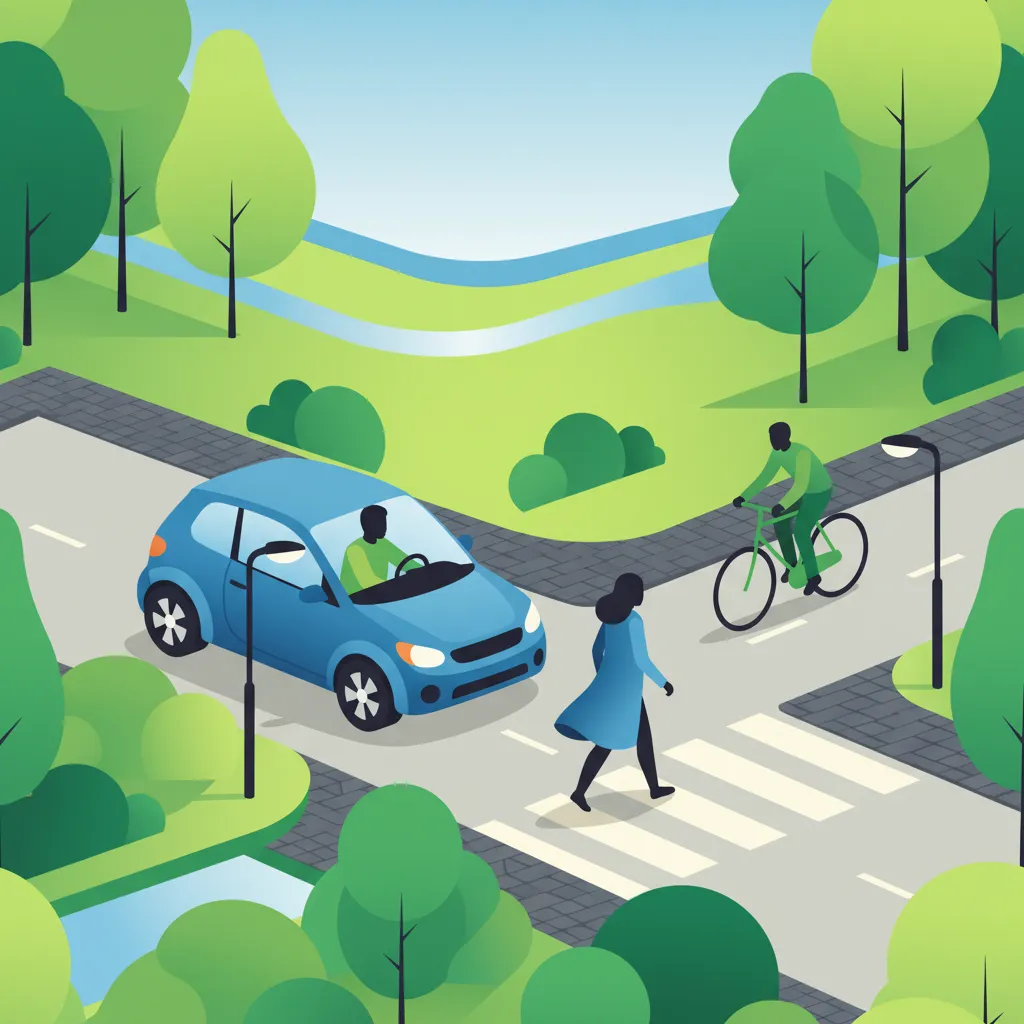
When turning, drivers must always give way to pedestrians and cyclists who are crossing the road you are entering. This applies whether they are crossing the road directly or using a designated cycle path or pedestrian crossing.
In the Netherlands, trams always have priority when turning, regardless of whether they are approaching from the front, side, or diagonally behind you. If a tram indicates it is turning, you must yield.
While not strictly a "turning" rule, remember that if you are turning from an unpaved road onto a paved road, you must give way to all traffic on the paved road, irrespective of other turning rules.
Understanding the nuances helps prevent typical CBR exam traps and real-world hazards:
dode hoek) is non-negotiable, especially for vulnerable road users. Failing to check it is a common fault.Safe turning in the Netherlands revolves around the principle of "See, Be Seen, and Yield." Always make comprehensive observations, especially the crucial blind spot check for cyclists. Clearly communicate your intentions with timely signals. Finally, understand that when turning, you often have a diminished right of way, especially towards oncoming traffic, pedestrians, cyclists, and always trams. Prioritise safety and assume responsibility for avoiding conflicts, particularly with vulnerable road users. This approach is key to passing your CBR exam and becoming a responsible Dutch driver.
Safe turning in Dutch traffic follows a structured process of observation, signalling, positioning, and execution while always yielding to vulnerable road users. The key principle is that turning drivers have reduced priority, particularly over oncoming traffic, cyclists, and pedestrians, and must perform mandatory blind spot checks. The short turn before long turn rule means right-turning vehicles have priority over left-turning vehicles at unmarked intersections. Trams hold absolute priority when turning, and signalling distances vary by location type (100m in urban areas, 200m rural, 300m on motorways). These rules, governed by Articles 17 and 18 of the Wegenverkeerswet, are heavily tested in the CBR theory exam and are essential for road safety in the Netherlands' cyclist-heavy traffic environment.
A short set of high-value points that capture the most important ideas from this theory explanation.
A safe turn requires four sequential steps: thorough observation (including blind spot check), clear signalling, correct road positioning, and smooth execution while yielding priority
When turning in the Netherlands, you must always yield to oncoming traffic going straight, pedestrians, and cyclists crossing your intended path
The 'short turn before long turn' rule means a driver turning right always has priority over a driver turning left from the opposite direction
Trams always have absolute priority when turning, regardless of approach angle, and drivers must yield completely
Road positioning varies by turn direction: position right for right turns, middle for left turns on single carriageways, far left on dual carriageways
Signal approximately 100m before turns in built-up areas, 200m outside built-up areas, and 300m on motorway exits
The mandatory blind spot check (dode hoek) cannot be replaced by mirrors alone, especially for detecting cyclists and mopeds
Article 18 of the Wegenverkeerswet governs turning priority rules and is a key exam topic
When both vehicles turning toward each other meet, the right-turning vehicle (short turn) always has priority over the left-turning vehicle (long turn)
Never enter an intersection if you cannot complete your turn without blocking it, regardless of your priority status
Forgetting that turning eliminates your priority over oncoming traffic going straight through the intersection
Relying solely on mirrors instead of performing the mandatory head-check over the shoulder for the blind spot
Signalling too late, giving other road users insufficient time to react and anticipate your maneuver
Focusing only on motor vehicles and failing to check for cyclists or pedestrians crossing the road you are entering
Underestimating tram priority; trams cannot swerve and always have right of way when turning
Start with a short, direct summary of Safe Turning Rules before reading the full explanation below.
To make a safe turn in the Netherlands, first observe your surroundings and check for all road users, including those in your blind spot. Signal your intention well in advance using your indicators or arm signals, then position your vehicle correctly in the lane. Always yield priority where required, especially to oncoming traffic, those on your right, pedestrians, and cyclists. Perform the turn smoothly and at an appropriate speed.
Review the most important terms, rule signals, and traffic concepts linked to Safe Turning Rules.
Explore related theory topic pages connected to Safe Turning Rules and continue with the next useful rule explanation.
See the common search queries learners use when trying to understand Safe Turning Rules in the Netherlands.

Ready to deepen your understanding? Browse our comprehensive library of Dutch driving theory topics, rules, and concepts. Each section offers detailed explanations to help you solidify your knowledge and prepare thoroughly for your upcoming CBR driving theory examination.
Explore Driving Theory TopicsTheory topic content overview
A short set of high-value points that capture the most important ideas from this theory explanation.
A safe turn requires four sequential steps: thorough observation (including blind spot check), clear signalling, correct road positioning, and smooth execution while yielding priority
When turning in the Netherlands, you must always yield to oncoming traffic going straight, pedestrians, and cyclists crossing your intended path
The 'short turn before long turn' rule means a driver turning right always has priority over a driver turning left from the opposite direction
Trams always have absolute priority when turning, regardless of approach angle, and drivers must yield completely
Road positioning varies by turn direction: position right for right turns, middle for left turns on single carriageways, far left on dual carriageways
Signal approximately 100m before turns in built-up areas, 200m outside built-up areas, and 300m on motorway exits
The mandatory blind spot check (dode hoek) cannot be replaced by mirrors alone, especially for detecting cyclists and mopeds
Article 18 of the Wegenverkeerswet governs turning priority rules and is a key exam topic
When both vehicles turning toward each other meet, the right-turning vehicle (short turn) always has priority over the left-turning vehicle (long turn)
Never enter an intersection if you cannot complete your turn without blocking it, regardless of your priority status
Forgetting that turning eliminates your priority over oncoming traffic going straight through the intersection
Relying solely on mirrors instead of performing the mandatory head-check over the shoulder for the blind spot
Signalling too late, giving other road users insufficient time to react and anticipate your maneuver
Focusing only on motor vehicles and failing to check for cyclists or pedestrians crossing the road you are entering
Underestimating tram priority; trams cannot swerve and always have right of way when turning
Start with a short, direct summary of Safe Turning Rules before reading the full explanation below.
To make a safe turn in the Netherlands, first observe your surroundings and check for all road users, including those in your blind spot. Signal your intention well in advance using your indicators or arm signals, then position your vehicle correctly in the lane. Always yield priority where required, especially to oncoming traffic, those on your right, pedestrians, and cyclists. Perform the turn smoothly and at an appropriate speed.
Review the most important terms, rule signals, and traffic concepts linked to Safe Turning Rules.
Explore related theory topic pages connected to Safe Turning Rules and continue with the next useful rule explanation.
See the common search queries learners use when trying to understand Safe Turning Rules in the Netherlands.
Ready to deepen your understanding? Browse our comprehensive library of Dutch driving theory topics, rules, and concepts. Each section offers detailed explanations to help you solidify your knowledge and prepare thoroughly for your upcoming CBR driving theory examination.
Explore Driving Theory TopicsUse this exam-focused revision tip to understand how Safe Turning Rules is likely to appear in theory questions for learners in the Netherlands. This section helps you identify the most testable part of the rule, avoid common traps, and remember the concept more effectively during Dutch driving theory exam preparation.
A common trap in the CBR theory exam involves turning priority. Remember that when turning, you generally give way to all oncoming traffic and road users crossing the road you are entering, including pedestrians and cyclists. Pay special attention to the 'short turn before long turn' rule and always yield to turning trams.
Read direct answers to the most common learner questions about Safe Turning Rules in the Netherlands. This FAQ focuses on rule confusion, practical meaning, comparison with similar concepts, and the exact uncertainties that appear most often in Dutch driving theory revision and exam preparation.
In the Netherlands, if two drivers are turning left at the same intersection from opposite directions, the driver making the 'short turn' (the one turning into the nearest lane) generally has priority over the driver making the 'long turn' (turning into the far lane).
You must signal your intention to turn well in advance. General guidelines in the Netherlands suggest signalling around 100 meters before turning within built-up areas, 200 meters outside built-up areas, and 300 meters before an exit on motorways.
When turning, you must always yield priority to pedestrians and cyclists who are crossing the road you intend to enter. This applies whether you are turning left or right, as they are considered vulnerable road users.
For a right turn, you should move as far to the right side of the carriageway as safely possible. This helps to guide your turn and prevents other vehicles from trying to overtake you on the right.
For a left turn, you should position your vehicle close to the middle of the road. If you are on a dual carriageway, take up a position as far to the left as possible to prepare for your turn.
Yes, turning trams always have priority over other traffic they approach from the front, are next to, or are diagonally behind. You must yield to a turning tram regardless of other priority rules.
Checking your blind spot is critical before and during a turn, especially for left turns. Cyclists and moped riders can easily be hidden there, and failing to check can lead to severe accidents. Always turn your head to look.
Leverage the targeted practice search to find questions that challenge your understanding of specific Dutch traffic rules or road signs. Focus your study efforts on areas where you need improvement and build a solid foundation for passing your CBR driving theory exam with confidence.